Rajgire Akhil Reddy — AI Engineer. I build agent systems — and the tools that explain why they do what they do.
01
About
Rajgire Akhil Reddy
AI Engineer
I got into this because I liked that things could be automated. That is the honest version — no origin story, no single moment.
What holds my attention now is narrower than "AI". It is mechanism: what the model is actually doing, what the architecture changes, what makes a system behave the way it does. The projects here keep circling the same question from different directions — Axon asks which piece of context caused an agent's decision and proves the answer by removing it; the floor plan paper chose a solver you can trace over a network you cannot; the traffic work is reward design, which is just the same question asked before training instead of after.
I would rather be an engineer who works on the problem and enjoys it than one who does things because someone said so.
Education
B.Tech, Data Science & Artificial Intelligence
Dr. Shyama Prasad Mukherjee IIIT Naya Raipur
2024 – 2028
Currently learning
FastAPI
Docker
Data structures & algorithms
Coursework
Machine Learning · Deep Learning · Advanced Machine Learning · Reinforcement Learning · AI for Autonomous Systems · Computer Vision · Statistical Data Analysis · Probability & Statistics · Linear Algebra · Design & Analysis of Algorithms
02
Selected Work
01
Multi-Agent Traffic Signal Control
Multi-agent reinforcement learning
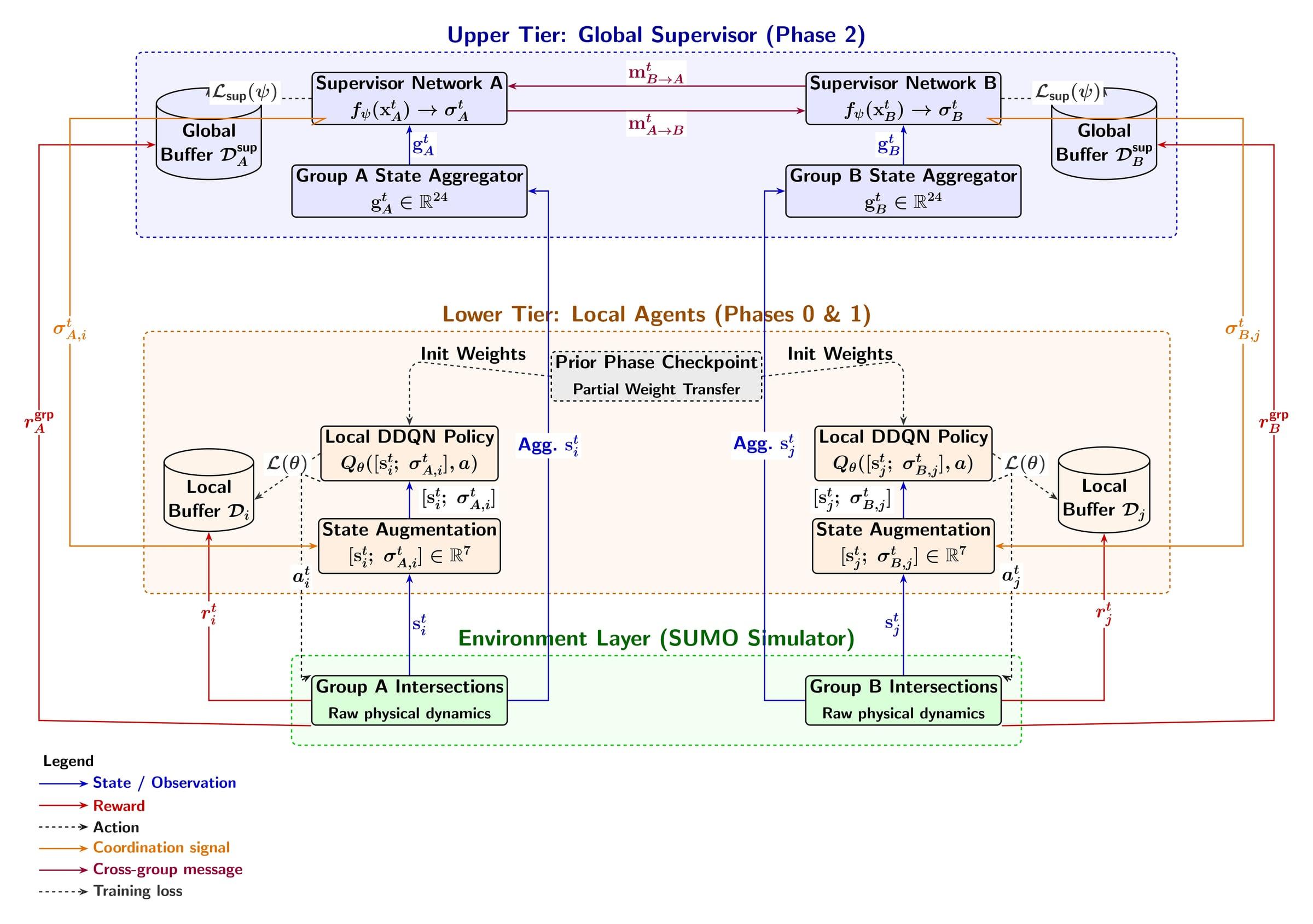
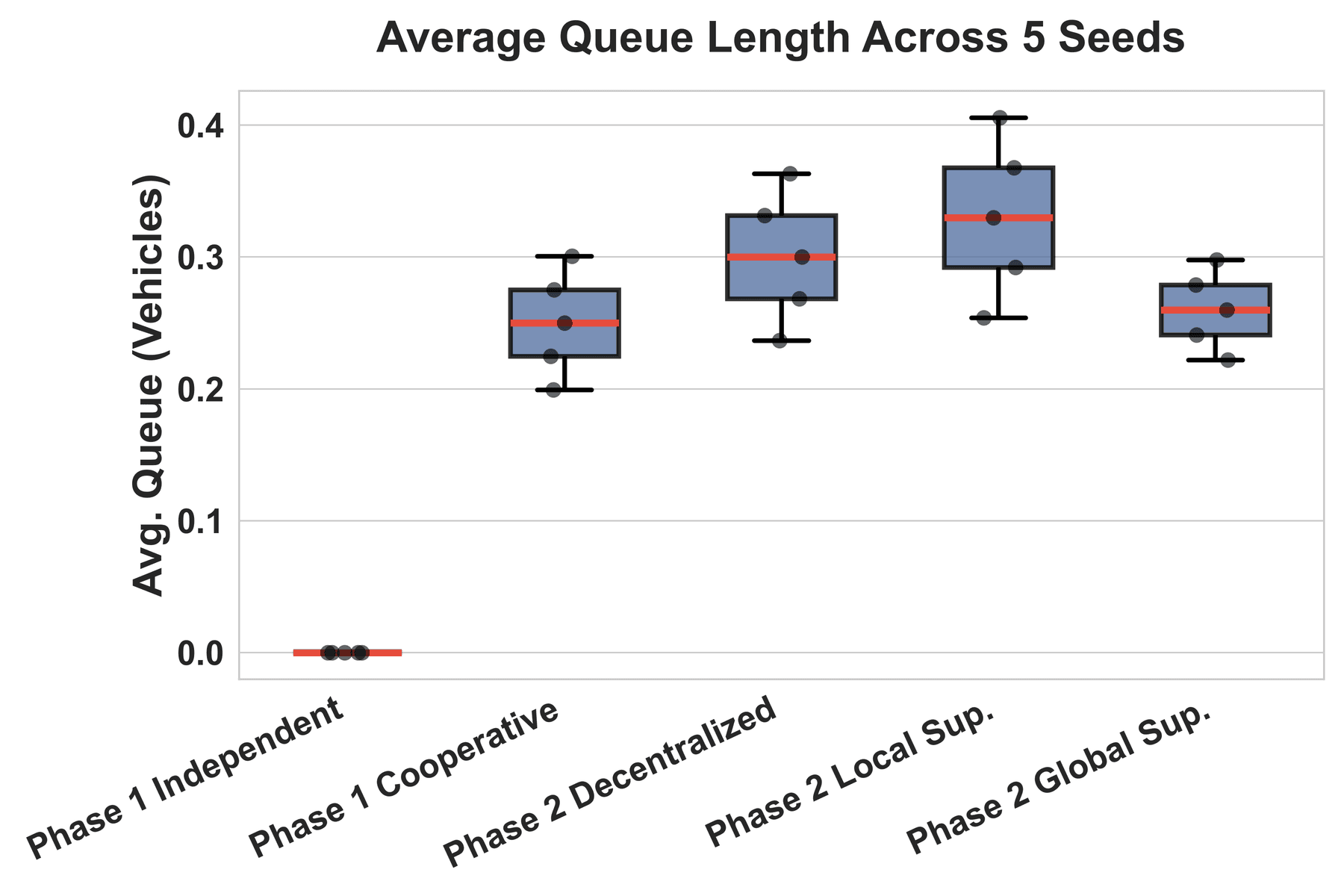
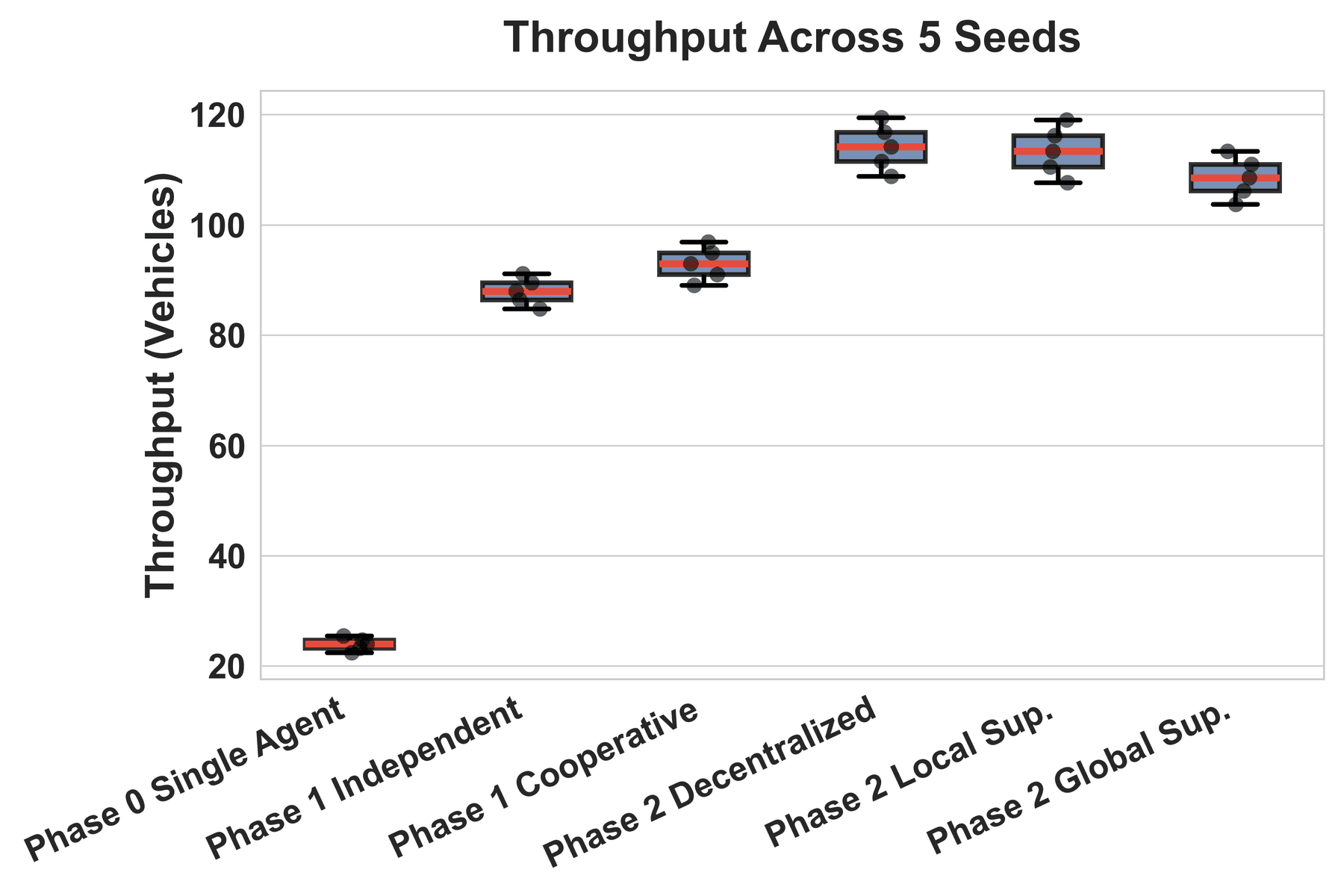
Four traffic signals learning to cooperate. Each intersection runs its own Double DQN agent and shares queue information with its neighbours, so the grid balances load instead of four controllers fighting each other.
TeamTeam project
My partReinforcement learning architecture and training — designing the agent architecture and getting it to train were the hard parts.
System architecture
Result
average wait-time reduction
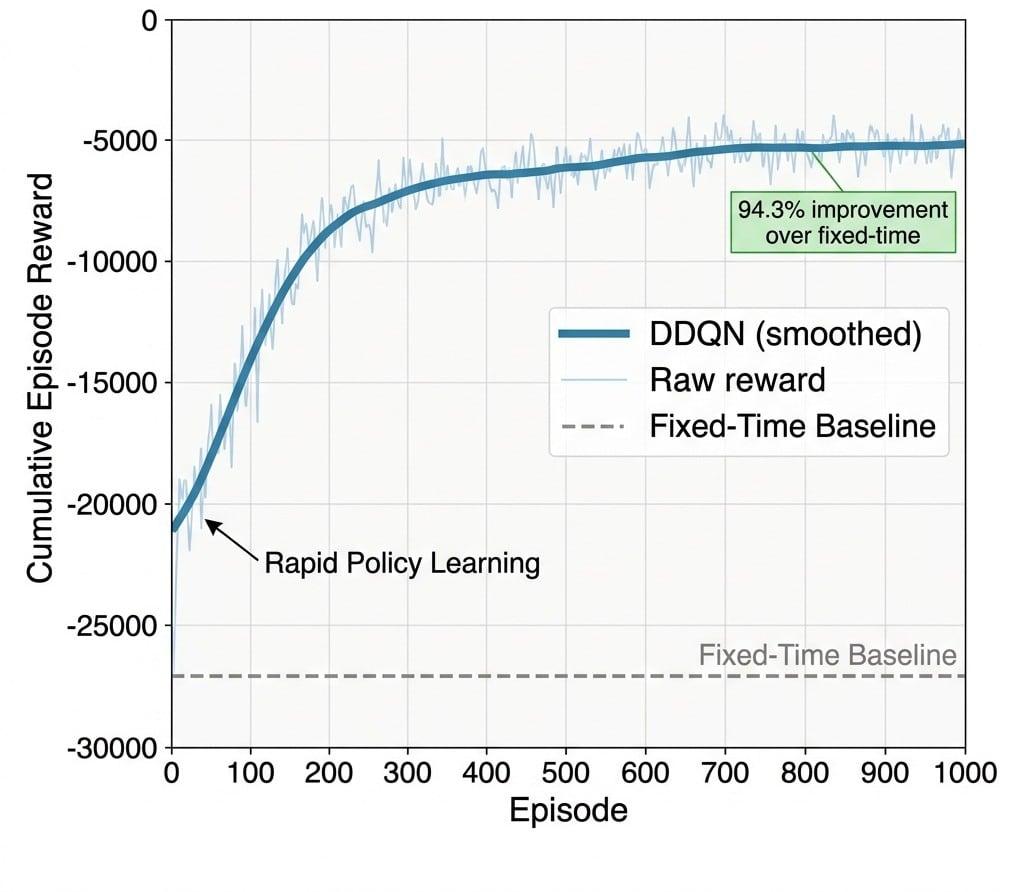
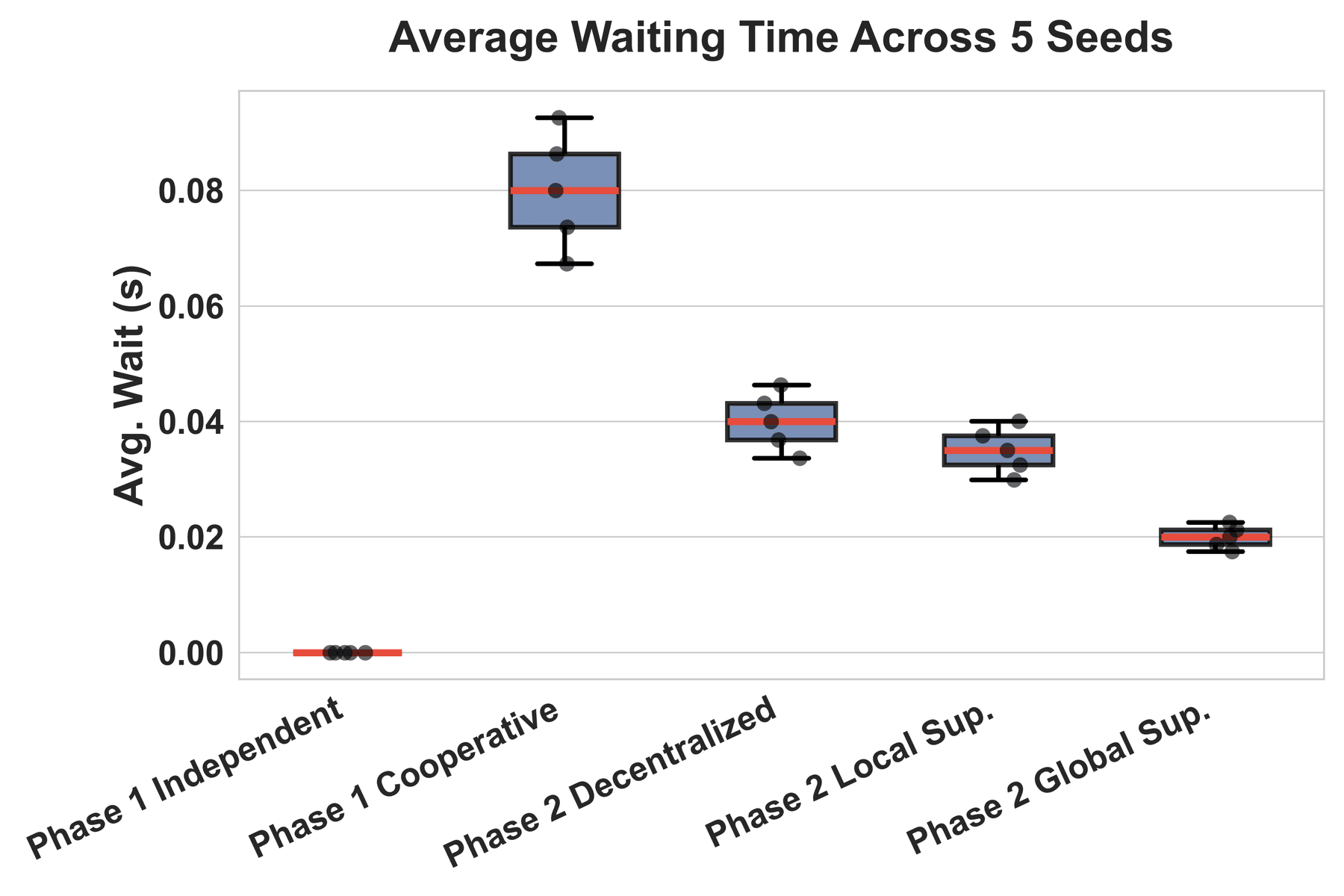
94.3%average wait-time reduction141s → 8s, against a fixed-time baseline
better per-intersection on a 4-agent network
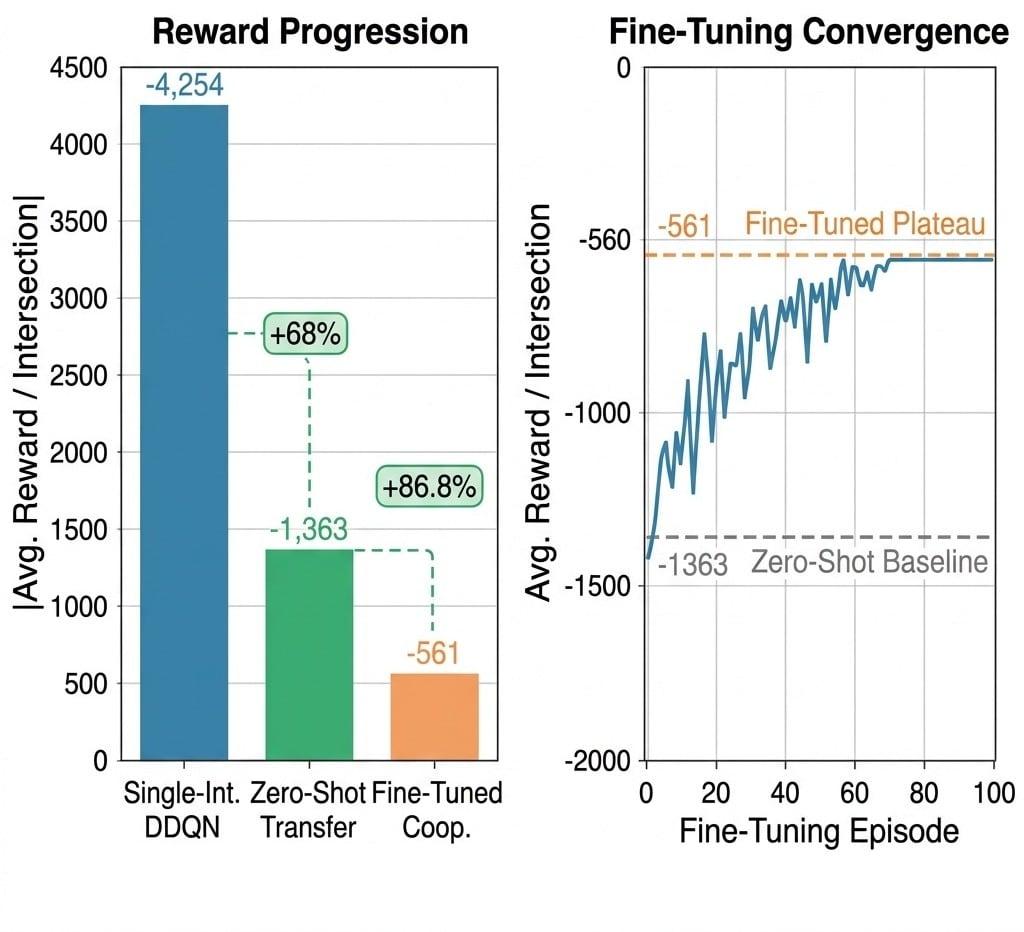
68%better per-intersection on a 4-agent networktransferred with zero additional training
over the single-agent baseline
86.8%over the single-agent baselineafter 100 episodes, versus 700 trained from scratch
faster convergence
~7×faster convergence
Problem
Fixed-time signals run a timer regardless of what is actually on the road. Queues build on one approach while an empty approach holds a green.
Approach
Model each intersection as a Double DQN agent over a 2×2 grid, simulated in SUMO. In cooperative mode every agent also sees its neighbours' queue state, so decisions account for what is about to arrive rather than only what is already waiting.
What made it hard
Designing the architecture of the RL system was hard, and training it was harder. Reward design is the whole problem — the reward penalises queue length, waiting time, and unnecessary phase switching, because an agent that flickers between phases can look good on paper while being useless on a road.
Outcome
94.3% average wait-time reduction against the fixed-time baseline, 141 seconds down to 8. A policy trained on the grid transferred to a 4-agent network with no additional training and still ran 68% better per intersection, converging roughly 7× faster than training from scratch.
Technical system
Double DQN with experience replay, PyTorch
SUMO traffic simulation, 2×2 intersection grid
Cooperative mode: neighbouring queue state shared between agents
Reward penalises queue length, waiting time and unnecessary phase switches
Transfer learning from the trained grid to a larger network
2D Floor Plan Generation via Constraint Satisfaction
Constraint optimisation · peer-reviewed research
Most floor plan generators are neural, need large labelled datasets, and land somewhere between 75% and 88% constraint satisfaction. This one is a constraint satisfaction problem solved with CP-SAT: no training data, deterministic output, and every hard constraint satisfied or no answer at all.
My partSecond author. Worked on the core CP-SAT logic.
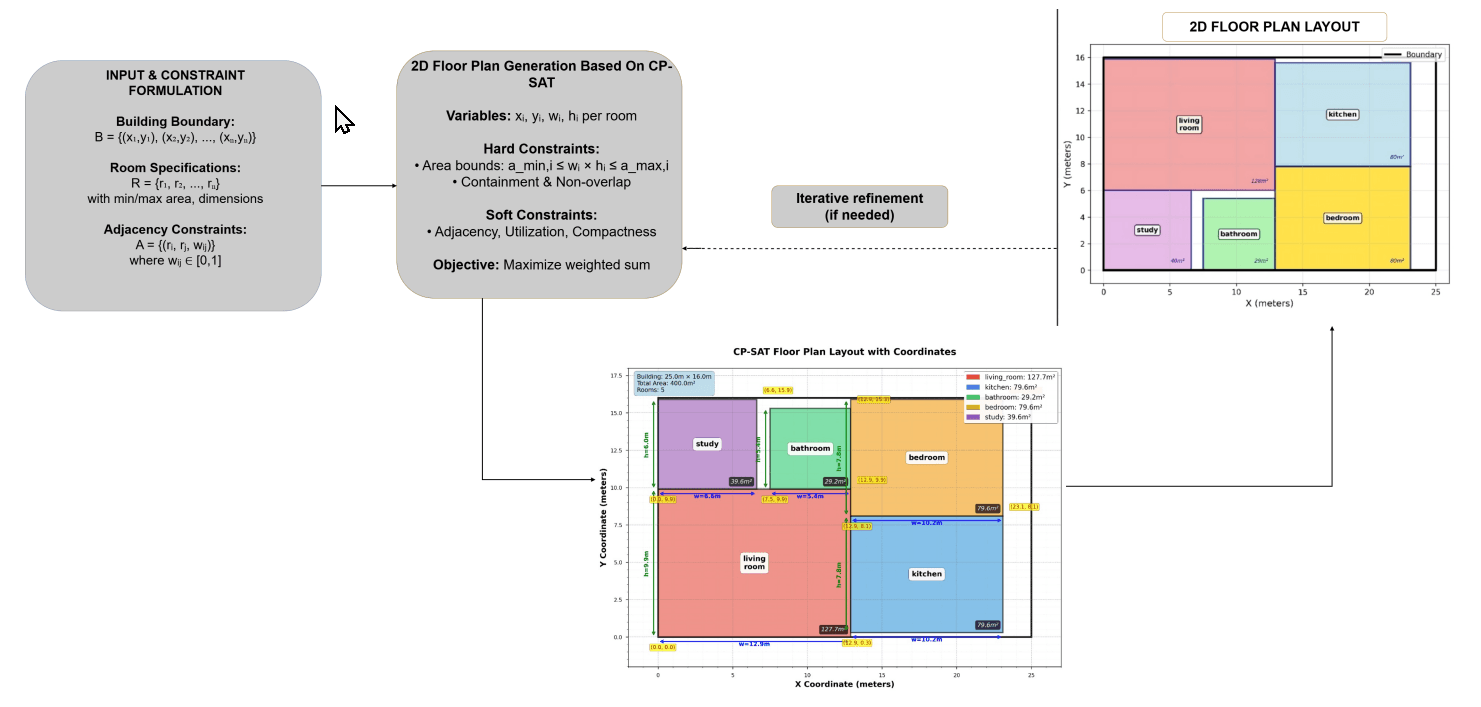
Figure 1 from the paper — the generation pipeline
Result
hard-constraint satisfaction
100%hard-constraint satisfaction400 m², 5-room layout, across 10 independent runs
space utilisation efficiency
85.82%space utilisation efficiency
adjacency satisfaction
81.40%adjacency satisfaction
average solve time
< 8saverage solve timefast enough to sit inside an interactive design loop
Problem
Generated floor plans are only useful to an architect if they are actually buildable. Neural generators produce plausible-looking layouts but offer no guarantee that rooms fit inside the boundary or avoid overlapping, and reported constraint satisfaction sits in the 75–88% range. In a domain where compliance is mandatory, a plan that is 88% feasible is not feasible.
Approach
Drop the generative model entirely and state the problem as what it actually is: a constraint satisfaction problem. Each room becomes four integer variables — x, y, width, height. Containment, non-overlap and area bounds become hard constraints. Adjacency preferences, compactness and space utilisation become a weighted soft objective. Google OR-Tools CP-SAT then either returns a layout that satisfies every hard constraint, or reports that none exists.
Outcome
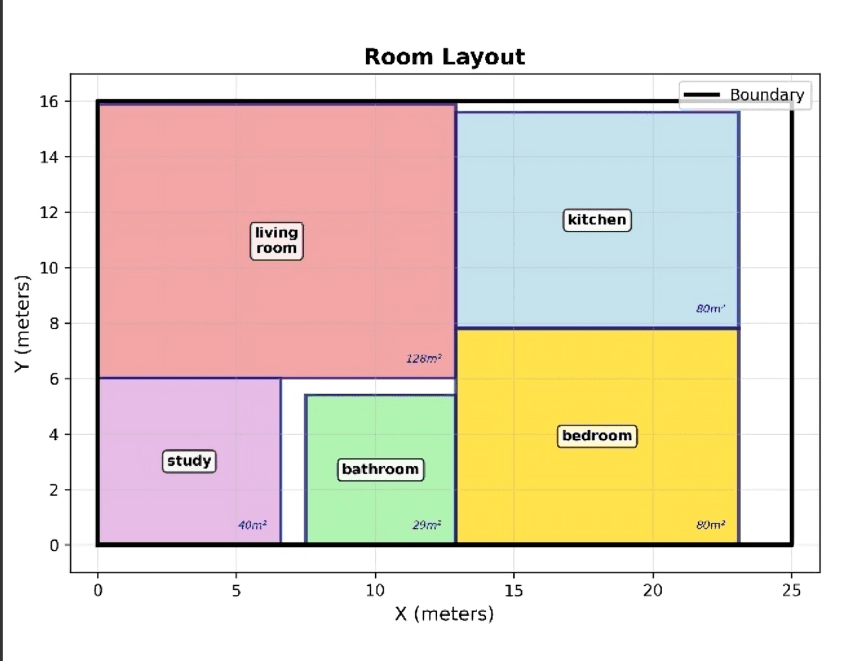
On a 25 m × 16 m footprint with five rooms, run ten times: 100% hard-constraint satisfaction, 85.82% space utilisation, 90% room compactness, 81.40% adjacency satisfaction, and an overall layout quality index of 89.38%. Average solve time under 8 seconds. No training data required, and every result is reproducible — the same input gives the same plan.
Technical system
Rooms as integer variables (x, y, w, h) on a 0.3 m discretisation grid
Hard constraints: boundary containment, non-overlap, per-room area bounds
Soft objective: weighted adjacency, compactness and space utilisation
Google OR-Tools CP-SAT v9.x, 30 second solver limit
NetworkX for the adjacency graph, matplotlib for the rendered plan
Figure 2 from the paper — a generated layout, 100% hard-constraint satisfaction
Most RAG systems treat a PDF as a flat wall of text. DocuSense parses the structure of a research paper — title, authors, venue, year, sections, citations — and uses it at query time. Every chunk is tagged with the section it came from, and every citation in an answer is checked against the sources it claims before you see it.
TeamSoloLive on Modal’s free tier. It sleeps when idle, so the first load takes a few seconds; after that, answers come back in about two seconds. Sign up and drop in a paper.
Landing — a page, annotated
Result
MRR from hybrid retrieval
+20.2%MRR from hybrid retrievalover vector-only, p = 0.0003
MRR from a cross-encoder rerank
+25.8%MRR from a cross-encoder rerankover hybrid alone, p = 0.0044 — it doubles P@1
of chunks left with no usable section label
27.3%of chunks left with no usable section labeldown from 62.6%
resident for both models on ONNX Runtime
326 MBresident for both models on ONNX Runtimeagainst 758 MB on torch, for the same numbers
Problem
A research paper is not flat. It has a title, authors, a venue, a year, sections and citations, and the section a passage came from is often what decides whether it answers the question or merely mentions the words in it. Most retrieval systems flatten all of that into undifferentiated text on the way in, and then have none of it left at the moment you ask.
Approach
Parse the structure on the way in and keep it. Title, authors, year, venue, DOI or arXiv ID, 20+ section types and both numbered and author-year citation styles are extracted at ingestion, and every chunk is classified from its full chain of enclosing headers — so “Experiments › Baseline Models” is tagged experiments rather than inheriting whatever heading came first. Questions are then answered by vector search for meaning fused with BM25 for exact terms, reranked by a cross-encoder, and every citation that comes back is checked against the retrieved sources by author and year.
What made it hard
Measuring it honestly, and then acting on what the measurement said. Running the ablation exposed that the shipped default had reranking switched off — the setting was being overridden by the pipeline’s balanced mode, so the system was scoring 0.2041 MRR, which is not significantly better than plain vector search (p = 0.16), while the same components configured as documented reach 0.2824. The gap was invisible until something measured it. Three features that were already built then turned out not to earn their place either. Section routing costs accuracy, because the evidence that answers a question is in the section it routes to only 13.3% of the time. LLM query rewriting costs 18% MRR, because the rewriter cannot see the corpus and invents the context an under-specified question is missing. Query expansion and intent classification reach nothing downstream at all. All three are still in the repo, switched off, with the numbers that killed them published rather than the features quietly removed.
Outcome
Evaluated on QASPER — 80 papers, 1,048 chunks and 259 questions with evidence grounded to real chunk ids, every arm answering the same questions so the comparison is paired, intervals from 10,000 bootstrap resamples. Hybrid retrieval is worth +20.2% MRR over vector-only, and a cross-encoder rerank a further +25.8% — it doubles precision-at-1, and it is where the query time goes. Running the embedding model and the reranker on ONNX Runtime rather than torch gives the same numbers to four decimal places for 326 MB resident instead of 758 MB, which is what makes free hosting possible. Deployed on Modal, answering in about two seconds once warm, with 338 tests passing.
Technical system
Ingestion: converters → preprocessing → paper metadata → section-tagged chunks
Qdrant for vectors, SQLite for documents and conversations
Retrieval: vector search + BM25 fused with Reciprocal Rank Fusion, then a cross-encoder rerank
Unsupported citations are deleted rather than shown — small models invent references even when told not to
Per-user isolation: documents, vectors, BM25 corpora and conversations are scoped to their owner, and cross-tenant reads return 404
Sessions are revocable server-side, which a signed JWT does not allow on its own
Generation is a seam — Ollama locally, a hosted model on Groq when deployed, retrieval unchanged either way
Conversational analytics over personal transactions
Bank alerts arrive as SMS and die there. LUMEN ingests them in real time, parses them into structured records, and lets you ask questions about your own spending in plain language. Built in a 24-hour hackathon window.
TeamFour-person teamBuilt and run locally — never deployed, so there is no live demo.
Landing
Result
transaction records indexed
1,000+transaction records indexed
semantic search
sub-secondsemantic search
Hack-A-Sol 2025
2nd placeHack-A-Sol 2025built in 24 hours
Problem
Transaction alerts are unstructured text scattered across an inbox. There is real data in there and no way to ask it anything.
Approach
Ingest SMS alerts through n8n webhooks, parse UPI, IMPS, NEFT and card formats with regex into structured records, embed them, and answer natural-language questions over the result with retrieval plus Gemini.
What made it hard
The whole thing was built inside a 24-hour hackathon window.
Outcome
Over 1,000 transaction records indexed with sub-second semantic search. Second place at Hack-A-Sol 2025.
Technical system
FAISS IndexFlatL2 vector index
Sentence Transformers all-MiniLM-L6-v2 embeddings
Gemini for response generation
Real-time SMS ingestion via n8n webhooks
Regex parsing for UPI / IMPS / NEFT / card alert formats
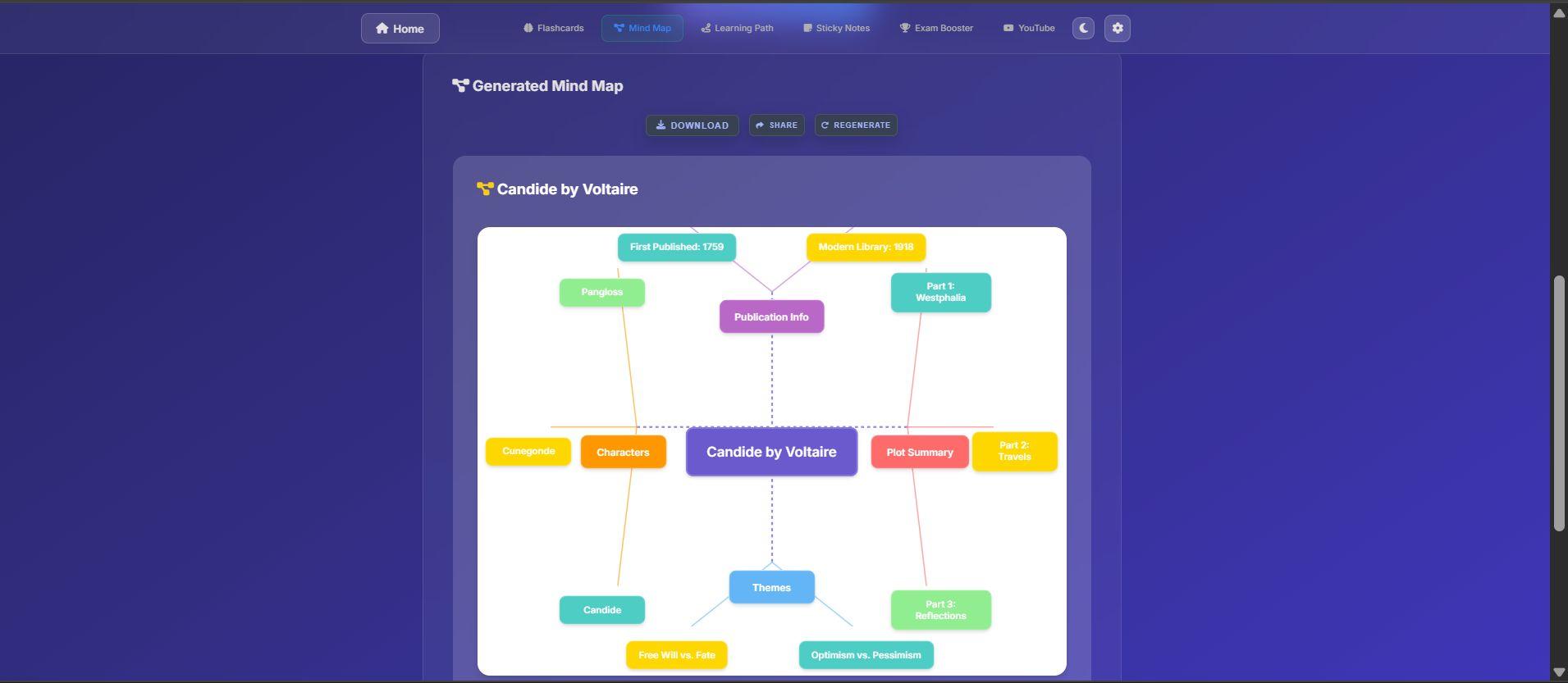
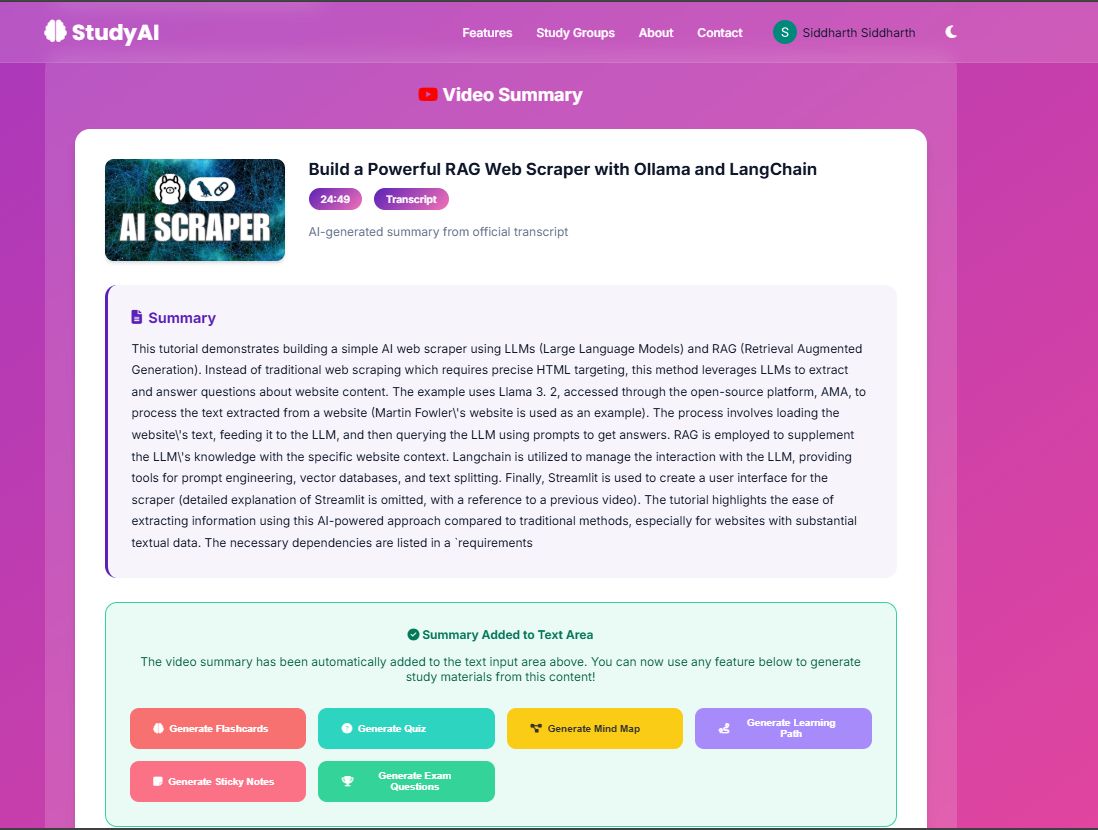
Course material does not arrive in one format. StudyAI takes PDFs, images, audio and YouTube video, grounds them in a single retrievable index, and turns them into flashcards, quizzes, mind maps and summaries you can question directly.
TeamFour-person teamBuilt and run locally — never deployed, so there is no live demo.
Landing
Result
APIhub.digital 2025
3rd placeAPIhub.digital 2025
Problem
Study material is split across formats. A lecture recording, a slide deck and a scanned page are the same subject, but nothing lets you ask a question across all three at once.
Approach
Normalise every input into text — OCR for images, Whisper for audio, transcripts for video — then index it all together with hybrid retrieval so answers stay grounded in whichever source actually contains them. Re-index automatically as new material lands.
Outcome
Third place at APIhub.digital 2025.
Technical system
Hybrid retrieval — FAISS dense vectors combined with BM25
Gemini and LangChain for generation and orchestration
OCR for images, Whisper transcription for audio, YouTube ingestion
Automatic re-indexing as material is added
OAuth2 / JWT authentication, collaborative study groups
Your agent picked the wrong tool. You open the trace. Everything looks fine — the prompt is right, the tools are there, retrieval returned the right chunk. You stare at it for forty minutes, end up guessing, change a tool description, and re-run to see if it helped.
Axon tells you which piece of context made it choose that, and proves it by putting the piece back and showing the choice flip.
In progress. Private repository — no link, no demo yet.
Edith
Building
Personal assistant
A personal assistant system. In progress.
In progress. Private repository — no link, no demo yet.
04
Experience
Jul – Aug 2025 · 1 month
InLighnX Global Pvt. Ltd.
AI/ML Training Program
Deep learning — pneumonia detection and real-time traffic sign recognition with CNNs, TensorFlow and OpenCV
Classical ML — fraud detection and churn prediction with XGBoost, gradient boosting and SMOTE
NLP — fake news detection and sentiment analysis with BERT, LSTM and TF-IDF
Preprocessing, exploratory analysis, model tuning and evaluation
Aug 2025 – Jul 2026
AIML Club
Core Member
Organised AI/ML workshops, hackathons and hands-on sessions for 100+ students
Coordinated technical events including the India AI Impact Summit 2026
March 2026
Udemy · Ed Donner
LLM Engineering: Building Production-Ready LLM Applications
Eight-week program, eight production LLM applications built
05
Research
2D Floor Plan Generation Via Constraint Satisfaction Problem Modeling
Accepted · in pressMMCITRE 2025
In final review before publication. No DOI yet.
Mathematical Modeling, Computational Intelligence Techniques & Renewable Energy